Description
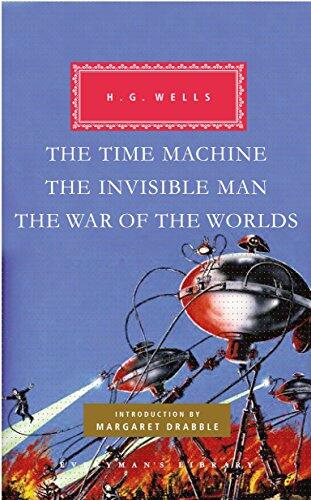
The first great novel to imagine time travel, The Time Machine (1895) follows its scientist narrator on an incredible journey that takes him finally to Earth’s last moments—and perhaps his own. The scientist who discovers how to transform himself in The Invisible Man (1897) will also discover, too late, that he has become unmoored from society and from his own sanity. The War of the Worlds (1898)—the seminal masterpiece of alien invasion adapted by Orson Welles for his notorious 1938 radio drama, and subsequently by several filmmakers—imagines a fierce race of Martians who devastate Earth and feed on their human victims while their voracious vegetation, the red weed, spreads over the ruined planet.
Here are three classic science fiction novels that, more than a century after their original publication, show no sign of losing their grip on readers’ imaginations.
Book Details
Genres
Reviews
View All
H. G. Wells - A Porta No Muro. 🧱
Mais uma leitura do ESK! 📚
Foi uma leitura interessante e também uma total viagem — mas no bom sentido!
Fiquei com a impressão de que H. G. Wells quis levar a história para um lado mais psicológico, com aquela porta representando uma espécie de fuga, um refúgio da realidade. Quanto mais eu pensava sobre isso, mais interessante a história ficava.
Uma leitura curta, diferente e que, apesar de simples à primeira vista, dá bastante espaço para interpretações e reflexões.

Under its thrilling Sci-Fi structure, the novel supplies a thorough analysis of the chasm which divided the different classes in late 19th century England.When the time traveler comes into contact with the Eloi for the first time, the palaces in which they lived and which had replaced the Victorian structure of houses and cottages suggest to his mind a communist evolution into a utopian world. In this manner, Wells imparts his viewpoint on the doctrine by focusing on the limited bodily and mental faculties of the Eloi. Having no more motivation to strive for under such a system humanity would simply collapse into a state of imbecility and childishness.Upon his meeting with the Morlocks, the time traveler's idea of the new world changes and takes the shape of a capitalist disaster in which the two main classes had grown so different that they ended up into different species which conveys the author's opinion regarding capitalism during the latter part of the 19th century.The subsequent discovery in regard to the Morlocks' cannibalism suggests an inversion of capitalism into some sort of dystopian socialism where the lower classes turn savagely against the well-to-do and the wealthy.The time traveler's sympathy for the Eloi and repugnance towards the Morlocks reflect Wells' social consciousness as the son of a shopkeeper who had failed in maintaining the family's economical security so that Wells' own mother had found herself under the obligation of seeking a position as a servant. This caused the author to nurture a constant fear of destitution and degeneration.